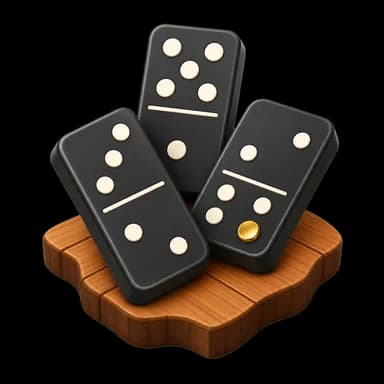
Domino 365 gives every open end a second meaning. Tiles still have to match, but after a placement the exposed ends can score whenever their total is a multiple of five. A quiet board can become ten, fifteen or twenty points with one carefully chosen tile.
PlayHub’s 365 format belongs to the broad All Fives family, with its own clear session rules. You race upward toward 365, the first double becomes a spinner, and the winner is confirmed at a natural round ending. That combination rewards arithmetic, timing and hand management in equal measure.
The short version
- Add all active open ends after every candidate move, not only the two ends of the main line.
- Multiples of five score; doubles count both halves while exposed.
- The first double is a spinner and can create up to four playable arms.
- Reaching 365 is not enough mid-round—the result is resolved when the round ends.
Where the 365 idea comes from
Scoring the exposed ends is a hallmark of the Fives family of domino games. All Fives and related variants developed many local names, targets and bonus rules, but share a satisfying core: place a legal tile, total the open ends, and score when that number lands on a multiple of five.
PlayHub turns that pattern into a longer session target of 365. It is not presented as the one universal definition of a game called 365; it is a consistent digital ruleset inspired by a well-established domino family.
How open-end scoring works
After a legal placement, add the pips visible at every active open end. If the total is divisible by five, the player scores that total. An exposed double contributes both halves: an open 6–6 contributes twelve, not six. Once another tile extends that arm, only the new outer end contributes.
The opening placement follows a special PlayHub rule: it scores only when each half of the first tile is itself divisible by five. A 5–0 can therefore score, while an ordinary 6–4 opening does not score merely because its halves total ten. The 0–0 opening remains worth zero.
- Open ends total 5: score 5.
- Open ends total 10: score 10.
- Open ends total 13: score nothing, but the move can set up the next turn.
The first double and the spinner
The first double played becomes the spinner. Tiles may extend from its sides as well as its ends, eventually producing up to four arms. Every unfinished arm becomes part of the open-end total, which is why spinner rounds can create larger scores and more branching choices.
Do not play a spinner only because it looks powerful. Ask whether your hand can support the new branches. Opening three values that favour the next players can hand them a scoring run; opening branches you can revisit lets you shape the board over several turns.
Round-end points and the race to 365
When a player empties their hand or the game blocks, PlayHub evaluates the pips left in the opposing hand. The hand total is rounded up to the next multiple of five before it is credited. To keep the late game competitive, hand-credit scoring is capped once a player has reached 300, while points earned directly from the board can still move the score forward.
A player who crosses 365 during a placement does not instantly interrupt the round. The session result is checked at the natural end of the round, and a unique highest score at or above 365 wins. This creates a meaningful finish: a trailing player may still answer before the tiles are exhausted.
A reliable Domino 365 strategy
Before touching a tile, calculate a small set of candidate totals. If the board ends are six and three, look for a move that changes one end to four or seven is impossible in a double-six set, so focus on reachable totals such as five, ten or fifteen. Two or three quick candidates are better than scanning every tile without a plan.
Separate scoring moves from setup moves. A zero-point placement can be excellent when it leaves a total that only you can convert, keeps a scarce suit under control, or unloads a dangerous high tile. The strongest turns often come from a setup followed by a score, not from taking the smallest available five immediately.
Track doubles and blank tiles closely. Doubles change totals sharply, while blanks can alter one side of the chain without adding pips. Near 365, also track the scoreboard: because the round must end, control of tempo and the ability to domino can matter more than one extra scoring placement.
Frequently asked questions
How do you score in Domino 365?
After a placement, total all active open ends. A total divisible by five scores that many points under PlayHub’s rules.
What is a spinner in dominoes?
In PlayHub 365, the first double played becomes the spinner. The layout can branch from all four sides of that double, and active branch ends count toward scoring.
Do you win the moment you reach 365?
No. PlayHub resolves the threshold at the natural end of the round. A unique highest score of at least 365 wins the session.
Is Domino 365 the same as All Fives?
It shares the open-end multiples-of-five idea with All Fives, but PlayHub 365 has its own target and round-end rules. Regional versions may differ.
Sources and further reading
History is reconstructed from surviving evidence, so responsible sources sometimes disagree on exact origins. Rules can also vary by family and region; this guide clearly marks the PlayHub format.