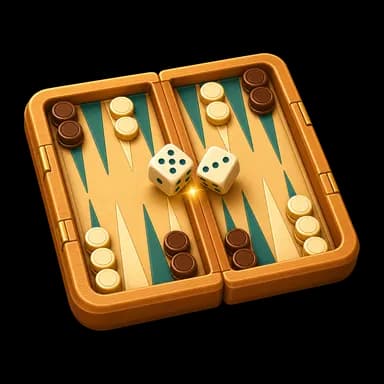
Long Nard looks peaceful beside backgammon: pieces are not hit and sent away. Yet the board can become intensely positional. Both players race in the same direction, every occupied point can deny space, and a six-point wall can decide whether an entire group moves at all.
Nard belongs to the broad family of race games played across the Middle East, the Caucasus, Central Asia and Eastern Europe. This guide separates the deep history of that family from the modern rules of Long Nard, then explains the PlayHub format in practical terms.
The short version
- All fifteen pieces begin on the head and travel in the same direction.
- There is no hitting: a point occupied by an opponent is closed.
- Normally only one piece may leave the head per turn, with limited opening-double exceptions.
- Build connected points, but never create a forbidden complete blockade in front of every opposing piece.
From ancient race games to modern Nard
Boards and playing pieces from the ancient Near East show that race games are thousands of years old. Finds associated with places such as Jiroft, dating to around 2000 BCE, are evidence of early board-game traditions. They are ancestors in a broad cultural sense, not proof that today’s Long Nard has been played unchanged for four thousand years.
The game family that includes backgammon is traditionally connected with Persia in late antiquity and later spread through trade, empire and everyday travel. Over centuries, communities developed distinct forms. Long Nard became especially familiar across the Caucasus and former Soviet region, where its no-hitting race remains both social and competitive.
Board, movement and objective
Each player starts with fifteen pieces stacked on a starting point called the head. Both sets move around the board in the same direction, complete the circuit, enter their home quarter and then bear off. The first player to remove all fifteen pieces wins.
Two dice determine movement. You may move one piece by both dice when the intermediate landing is legal, or move separate pieces. A double gives four moves of the rolled number. You must use the available dice whenever legal moves exist, following the table’s priority rules when only one die can be played.
The head rule and opening doubles
Normally, only one piece may leave the head during a turn. This prevents a lucky roll from releasing the entire stack too quickly and makes development a deliberate process. Certain opening doubles—commonly 3–3, 4–4 and 6–6—need a special exception because playing all four moves from one released piece would be impossible; the rules allow an additional head piece in those cases.
The head rule makes your first released pieces unusually important. One piece races forward to claim space while later pieces connect behind it. If the leader moves too far without support, the opponent can occupy key points and leave your stack with nowhere useful to go.
Blocks, primes and the no-hitting difference
A point containing any opposing piece is closed—you cannot land there. Because pieces are never hit, ownership of a point is stable until its player moves away. Several consecutive owned points form a wall or prime that can restrict the opponent’s dice.
A full six-point blockade is powerful enough to stop every possible roll, so Long Nard limits when it may be formed. You cannot seal all opposing pieces behind an impassable six-point prime; at least one opponent piece must already be ahead of the wall under the standard rule. PlayHub enforces legal placements, which makes this subtle restriction easier to learn.
Long Nard strategy for a stronger race
Think in connected zones, not isolated pieces. Early anchors two or three points apart create landing options for many rolls. A single advanced runner can claim a valuable point, but too many gaps make future doubles difficult to use.
Balance release and progress. Pieces trapped on the head are wasted potential, yet repeatedly taking pieces off can leave all fifteen crowded in the opening quarter. Use ordinary rolls to develop new pieces when the route is safe, and use doubles to move groups through the board before traffic builds.
Before bearing off, distribute pieces across several points. A tall stack on one number depends on exact rolls and wastes larger dice. A smooth home board lets almost every throw remove something. Late in the game, count total pips for the race but also inspect playable structure; fewer pips do not help when your next roll has no clean move.
- Create two-way landing options before chasing a perfect wall.
- Use blocking points to reduce useful opponent rolls, not merely to occupy space.
- When ahead, favour safe, efficient movement; when behind, create controlled obstacles that add variance.
Frequently asked questions
What is the difference between Long Nard and backgammon?
In Long Nard both players travel in the same direction, pieces are not hit, all fifteen begin on the head, and blocking rules are central. Backgammon uses opposing directions, separated starting groups and hits.
Can you hit a piece in Long Nard?
No. A point occupied by an opponent is simply closed, even if it contains only one piece.
How many pieces can leave the head?
Normally one per turn. Specific opening doubles receive a limited exception so all required moves can be played.
Is Nard entirely decided by dice?
Dice create uncertainty, but development, point control, prime timing, move order and bear-off structure strongly affect how many rolls remain useful.
Sources and further reading
History is reconstructed from surviving evidence, so responsible sources sometimes disagree on exact origins. Rules can also vary by family and region; this guide clearly marks the PlayHub format.